AI Is a Workflow Problem.
AI is a workflow redesign problem, and teams that treat it as a button lose to teams that rebuild how work moves.
Every major tooling shift of the last two decades followed the same arc. Early adopters move fast. The majority waits. And by the time the majority catches up, the real advantage has already gone somewhere else. We're in that moment again, except the gap is wider than it's ever been. The conversation has been dominated by tool announcements and anxiety about replacement. Neither gets you anywhere. What actually matters is less flashy: moving from AI as a feature to AI as a workflow redesign problem.
The easy gains from bigger models are largely behind us. The bigger story now is about what happens when AI moves out of the demo and into the actual work.
Two things are happening at once
There are two parallel movements underway. The difference matters.
The first is AI getting bolted into existing software. Microsoft Copilot in Office. Google Gemini in Docs and Gmail. Legacy product management tools adding a "summarize this" button. These integrations are real and they're useful. But they're also limited. You're getting a 10-30% productivity improvement on individual tasks. The underlying process, with all its handoffs, silos, and friction, stays exactly the same.
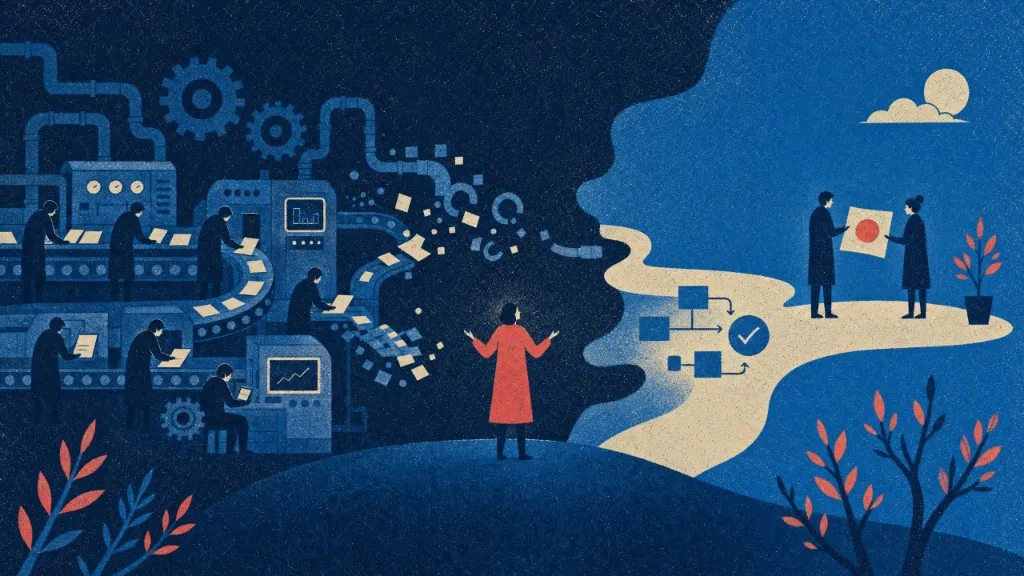
The second movement is more significant. It's applications being rebuilt around AI from the ground up. Platforms designed from the start to use AI as the operating model. The difference is structural.
Adding AI to an old process makes the process faster. Redesigning the process around AI can eliminate entire steps, and sometimes entire roles.
The real bottleneck in product and UX work
Most product teams are short on time to validate their ideas.
A typical discovery cycle looks like this: a PM or researcher identifies a problem, conducts interviews, manually synthesizes findings into a report, writes a PRD, waits for design, waits for engineering, and finally ships something, only to discover the original assumption was slightly off. The whole loop can take months. And by the time you get signal, the market has moved.
The bottleneck is the time between insight and a validated decision.
What I've seen firsthand: most teams are spending the majority of their time in delivery, standups, documentation, alignment meetings, expectation management, and almost none of their time in real discovery. The result is safe, derivative product decisions. Teams copy competitors because they can't afford to explore anything else.
"AI doesn't fix this by making the meetings shorter. It fixes it by eliminating the need for most of them."
Where the redesign actually happens
The gains that matter come from teams that have redesigned the entire chain of work.
Three places workflow redesign pays off
Manually transcribing and tagging user interviews used to take days, and even then, synthesis was bounded by whoever had time to do it. That constraint is gone. AI-native research platforms now handle transcription, theme extraction, and insight clustering automatically, and they do it across your entire research history, beyond just the last sprint. When a PM can query two years of user interviews in real time, discovery stops being a periodic activity and becomes a continuously updated picture of what users actually need.
The gap between design intent and what gets built has always been one of the most expensive inefficiencies in the product lifecycle. Designers redline files. Developers interpret, which means they sometimes misinterpret. QA cycles stretch. Design debt accumulates quietly until it isn't quiet anymore. When design context, variables, styles, component logic, lives directly in the developer's environment, AI can generate brand-compliant, accessible front-end code without a translation layer. The design system stops being a reference document and starts being an active constraint on what ships.
Getting a navigable prototype in front of users used to require a designer, an engineer, and a lead time measured in weeks. That lead time is now measured in hours. A PM or designer can generate something testable directly from a structured brief, not a static mockup, something a user can actually interact with. When prototyping is cheap, you test more bets. When you test more bets, you make fewer expensive mistakes.
Don't start with tools. Start with bottlenecks.
This is the mistake I see most often. Teams go looking for AI tools before they've identified what's actually slowing them down. They end up with a stack of subscriptions and no meaningful change in how work gets done.
The right starting point is a simple question: which parts of our product process are highly repeatable, information-heavy, and vulnerable to human delay or handoff friction?
AI pays off in the connective tissue between the work: transcription, documentation, synthesis, and translation between disciplines. Creative, judgment-intensive work still requires humans. That is where hours disappear, and where redesigning the workflow pays off.
Who owns the redesign?
This is where most organizations stall. The workflow problem gets identified, everyone agrees it's real, and then it sits in a no-man's-land between product, engineering, and design, each team waiting for someone else to take the first move.
The answer, in the organizations I've seen get this right, is design operations or product operations. They have the right vantage point. They sit at the intersection of process, tooling, and craft. They can see where handoffs break down. They understand both the design system and the delivery pipeline. And they're not so deep in execution that they can't look up and ask: why are we doing it this way?
That cross-functional visibility is exactly what workflow redesign requires. This is a systems problem, and the people who think in systems are the ones who should be leading it.
This also means that design ops and product ops are in a different position than they were two years ago. The role used to be about creating consistency and reducing friction at the margins. Now it's about something bigger: figuring out which parts of the organization's product process are ready to be rebuilt, and building the case for doing it. That's a strategic seat, if they choose to take it.
The standard for execution just went up
Here's the mental model shift that matters most: AI doesn't lower the bar for what good looks like. It raises it.
When everyone can move faster, the advantage shifts to the teams that make better choices. When prototyping is cheap, the differentiator becomes the quality of what you're testing. When research synthesis is automated, the differentiator becomes the sharpness of the questions you're asking.
Mediocre execution becomes harder to defend. The table stakes just went up.
A lot of product and design teams are using AI to protect the old model, to do the same work with less effort. That's the wrong frame. The better question is what becomes possible now that the economics of building have changed.
Better questions to be asking
The teams that win with AI won't be the ones who automated their existing process. They'll be the ones who looked at what the automation made possible, and redesigned around that.
"AI raises the standard for what disciplined execution looks like. That's the conversation worth having."
FAQ
Why isn't AI just another product feature?
Feature bolt-ons improve individual tasks by roughly 10 to 30% while leaving handoffs, silos, and process friction intact. The durable advantage comes from redesigning the workflow around AI, not from adding a summarize button to the old process.
Who should own AI workflow redesign inside a product org?
In organizations that get this right, design operations or product operations usually own it. They sit at the intersection of process, tooling, and craft, and can see where handoffs break without being buried in day-to-day ticket execution.
What should teams ask instead of 'which AI tool should we buy?'
Ask what becomes possible now that building and feedback loops are cheaper: which user value was previously uneconomical, which internal friction is now optional, and which decisions can move from weeks to hours with better evidence.
Weekly
One email a week on product experience and AI-enabled delivery
What I'm working on, what broke, and what I'd do differently. Written for people running product organizations.