The Rules and Agents System: Making the Process Repeatable
The Rules and Agents System: Making the Process Repeatable
Last month I realized something embarrassing: I was treating product creation like jazz improvisation when I should have been treating it like architecture. Here's how I fixed it with 300 rules and 12 AI agents.
The "Oh Crap" Moment
Three weeks ago, I caught myself doing it again. Staring at a half-built feature that nobody wanted, wondering how I'd burned through two weeks of engineering time without validating basic demand.
If that sounds familiar, you're not alone.
I've been building products for years, but I was treating each new idea like a completely fresh problem. No process. No checklist. Just "gut feel" and hope that this time would be different.
Then it hit me, what if I approached product creation the same way I approach code? With systems, rules, and repeatable processes that actually work?
That lightbulb moment led me to build something I'm calling the "Rules and Agents System", a framework that's transformed how I validate, design, and build products. And honestly? It's saved me from more bad decisions than I care to admit.
"What if I approached product creation the same way I approach code? With systems, rules, and repeatable processes that actually work?"
The Framework: Rules + Agents + Gates
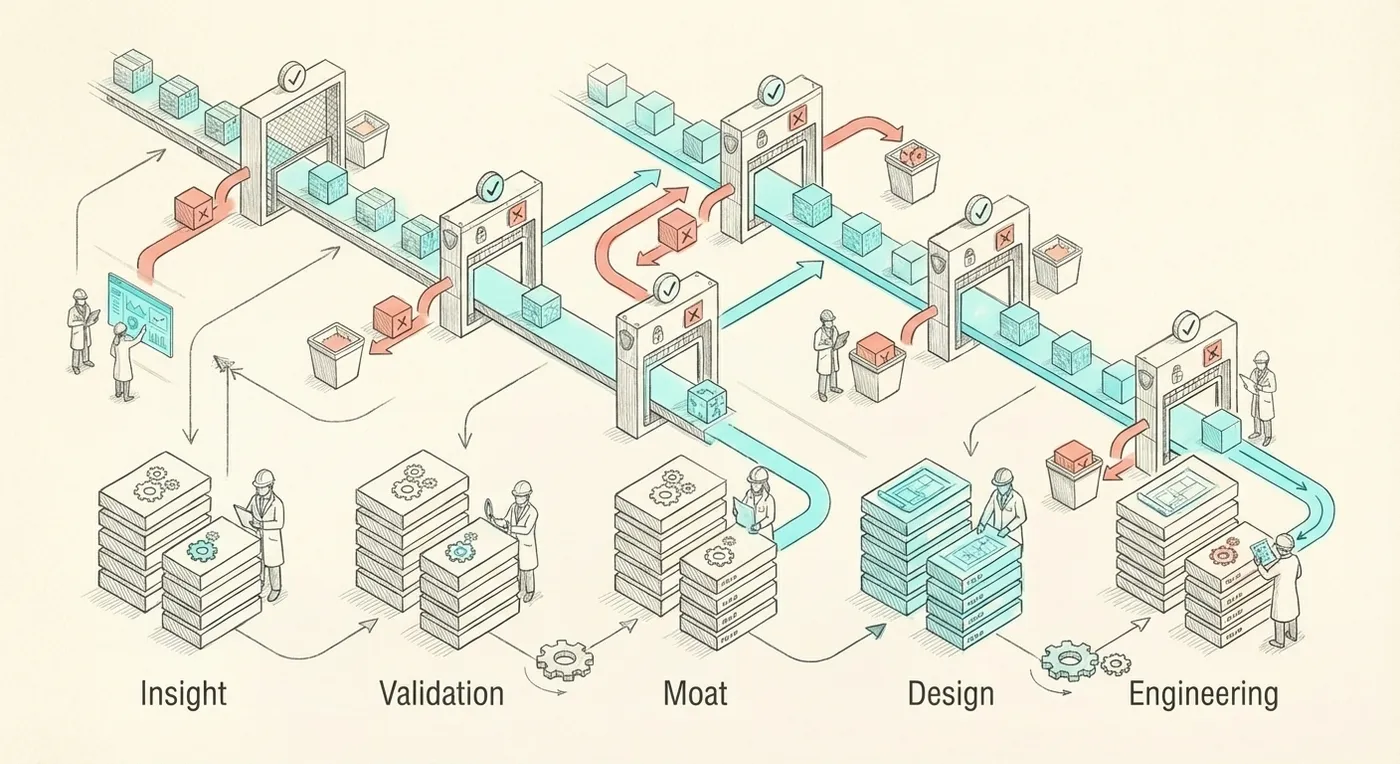
The system has three core components, and they work together like a well-orchestrated team:
300+ Rules that codify everything I've learned about product creation. Not fluffy guidelines, actual, enforceable rules like "No feature enters engineering without 3+ lo-fi validation tests."
12 Specialized AI Agents that handle different phases of the process. Think of them as your most competent colleagues, each with deep expertise in their domain.
Quality Gates that act as checkpoints. You can't move to the next phase until you've proven your work meets the standards.
Real talk: This might sound over-engineered, but it's actually liberating. Instead of reinventing the wheel every time, I have a system that catches my blind spots and keeps me honest.
System Impact
The Rules System: My Product Creation Constitution
Let me show you what I mean by "rules." These aren't vague principles like "validate early", they're specific, actionable guidelines that my system can actually enforce.
For example, here's one from my Validation Playbook:
# Core Rule: Desirability First
No feature or product may enter engineering until
desirability is validated via 3+ lo-fi tests with
target users showing 70%+ positive intent
See how specific that is? That is what validation looks like, with numbers and criteria.
My rules cover six major phases:
- Portfolio & Insight: Scoring ideas and validating unfair advantages
- Validation: Proving people actually want this thing
- Moat & Retention: Designing defensibility (because growth without retention is expensive)
- Monetization: Mapping how money flows through the system
- Design: User flows, interactions, accessibility, the whole experience
- Engineering: Architecture decisions that won't make me cry later
Each phase has its own "playbook", a collection of interconnected rules that define inputs, outputs, and quality standards. It's like having a pedantic but helpful colleague who never lets you skip steps.
The Agent System: Your AI Dream Team
Now here's where it gets interesting. I've got 12 specialized AI agents, each one laser-focused on a specific part of the process. They work together like the world's most efficient product team.
Let me introduce you to a few of my favorites:
The Insight & Narrative Strategist takes my half-baked ideas and turns them into compelling "unfair insights", those counterintuitive truths that make people go "wait, that's actually genius." This agent saved me from building yet another generic productivity app by uncovering that remote workers don't need more features, they need apps that adapt to their psychological state.
The Product Strategist is basically the PM I wish I'd had on every project. It creates PRDs that actually matter, not feature lists, but value stories with "why now" analysis and validation plans. Plus, it runs demand-validation tests before I get emotionally attached to ideas.
The Moat & MRR Strategist is my secret weapon against commodity products. It designs defensibility strategies, network effects, data moats, switching costs, that keep competitors at bay. Because building something people want is hard enough; building something they can't easily replace is the real challenge.
Quick tangent: I spent six months building a tool that competitors copied in three weeks. The Moat Strategist would have caught that vulnerability in the planning phase. Live and learn, right?
The Retention Architect maps the complete journey from signup to renewal, habit loops, notification triggers, collaboration hooks. It's the agent that asks uncomfortable questions like "Why would someone still use this in six months?"
These agents don't work in isolation. The output from one becomes input for the next, creating a clean handoff that prevents things from falling through the cracks.
Quality Gates: The Reality Checks
The quality gates are where the rubber meets the road. Think of them as checkpoints where my system asks, "Are you sure you want to keep going?"
Here's what the gates look like for my "Insight & Validation" phase:
- Insight & Narrative Strategist completes an "Unfair Insight" brief
- Product Strategist validates desirability via 3+ lo-fi tests
- Portfolio Prioritizer approves based on expected value
- Moat & MRR Strategist confirms defensibility strategy
All four gates have to be green before anything moves forward. No exceptions. No "we'll figure it out later."
The beautiful thing about gates? They force kill-or-pivot decisions early, when it's cheap to change course. I've killed more bad ideas in the last month than I used to kill in a year, and that's a good thing.
Before vs. After Quality Gates
Before: Chaos Mode
- • Build first, validate later (or never)
- • Emotional attachment to bad ideas
- • Discover problems after engineering starts
- • "Just one more feature" syndrome
After: Systematic Validation
- • Evidence-based progression through phases
- • Kill bad ideas before they're expensive
- • Clear criteria for each decision point
- • Focus on proven opportunities
Real Examples (Because Abstract Is Boring)
Let me show you this system in action with actual examples from my recent projects:
Example 1: The Productivity App That Almost Wasn't
I had this idea for a productivity app. New concept, right? 🙄
My Insight & Narrative Strategist dug deeper and uncovered something interesting: Remote workers don't struggle with productivity because they lack discipline, they struggle because existing apps are too rigid for the psychological chaos of working from home.
The unfair insight? "Productivity apps should adapt to your mental state, not force you to adapt to their system."
That insight completely changed the product. Instead of another task manager, we built something that reads your work patterns and adjusts its approach based on your energy levels and focus state.
Example 2: Building Moats That Actually Hold Water
For a SaaS marketplace I was designing, the Moat & MRR Strategist identified three defensibility layers:
Network Effects: Buyers attract sellers, sellers attract buyers, classic but effective.
Data Moat: Rich behavioral data lets us personalize matching algorithms that competitors can't replicate without similar data.
Switching Costs: Deep integrations with existing workflows make leaving expensive and painful.
The Retention Architect then mapped habit-forming features, collaboration triggers, and renewal mechanisms around those moats. The result? A product strategy that's actually defensible, beyond just feature-rich.
Example 3: Accessibility as a First-Class Citizen
Here's something I used to screw up constantly: accessibility as an afterthought.
Now, my IA Designer maps complete user flows with accessibility in mind from day one. The Accessibility Agent performs WCAG 2.2 AA audits on designs before any code gets written.
The result? Products that work for everyone, beyond the "typical" user. And honestly, accessible design is usually better design for everyone.
"I've killed more bad ideas in the last month than I used to kill in a year, and that's a good thing."
How to Build Your Own Rules & Agents System
Alright, you want to try this yourself? Here's how to get started without building a complete AI orchestration platform:
Start Small, Think Big
Map Your Phases: What are the major stages in your product creation process? Mine are Insight → Validation → Moat → Design → Engineering. Yours might be different.
Write Your Rules: For each phase, what are the non-negotiable requirements? Start with 3-5 rules per phase. Make them specific and measurable.
Assign Your Agents: Who (human or AI) is responsible for each phase? Even if it's just you wearing different hats, be explicit about the role each "agent" plays.
Set Your Gates: What must be true before moving to the next phase? Be ruthless here, fuzzy gates defeat the purpose.
Make It Enforceable
The magic isn't in having rules, it's in actually following them. Start with simple enforcement mechanisms:
- Checklists for each phase
- Templates that force you to address key questions
- Regular reviews with clear go/no-go criteria
- Automated reminders for quality gates
You don't need fancy software. Google Docs, Notion, or even paper can work if you're disciplined about using them.
Integrate with Engineering
This is crucial: your product creation system should feed directly into your development workflow. No handoff friction, no "lost in translation" moments.
For us, that means technical specs flow automatically from our agents into engineering backlogs. For you, it might be as simple as a standardized handoff template.
What I resisted about process
Part of me resisted this level of systemization for years. It felt constraining, bureaucratic, corporate.
But here's what I learned: Good process doesn't limit creativity, it creates space for it. When I'm not constantly making the same validation mistakes, I can focus on the challenges that actually require creative thinking.
Plus, having a systematic approach means my wins are repeatable, beyond lucky accidents.
Real talk: The first time through this system felt slow and over-engineered. By the third product, it felt like having superpowers. The learning curve is worth it.
What This Actually Looks Like in Practice
When I start a new product idea now, here's my actual workflow:
I spend 30 minutes with my Insight Strategist exploring the idea from different angles. Is this solving a real problem? What's the unfair insight that makes this non-obvious?
If that passes the smell test, the Product Strategist takes over. Lo-fi validation tests, demand scoring, early adopter profiling. This usually takes 2-3 days, not weeks.
Only if validation looks strong does the Moat Strategist get involved. Can we defend this? How do we create switching costs? What's the expansion revenue model?
By the time engineering starts, I've got validated demand, a defensibility strategy, and clear success metrics. It's not perfect, but it's evidence-based.
The Bottom Line
Here's what I wish someone had told me five years ago: Product creation isn't art, it's craft. And like any craft, it gets better with systematic practice and accumulated wisdom.
The Rules and Agents system creates structure so creativity can focus on problems that actually matter.
Will this approach work for everyone? Probably not. Some people thrive in chaos, and that's fine. But if you're tired of building things nobody wants, if you want your product wins to be repeatable instead of accidental, this systematic approach might be exactly what you need.
The best part? You don't need to build 12 AI agents and 300 rules to get started. Pick one phase, write three rules, enforce them religiously. See what happens.
My guess? You'll never go back to winging it.
What if your product creation process was as systematic as your code? Try it for one project and find out.
Want to Build Your Own Rules System?
I'm documenting my complete Rules and Agents framework, including templates, checklists, and implementation guides.
Weekly
One email a week on product experience and AI-enabled delivery
What I'm working on, what broke, and what I'd do differently. Written for people running product organizations.