The Results: What We've Learned Building This System
Building a Product Creation Engine: What Actually Works (And What Doesn't)
After a year of building systematic product validation, we learned a few things, AI orchestration, dual filters, and why documentation isn't boring.
Last Tuesday, I watched a startup founder spend three hours explaining why their "big new" idea was going to change everything. Two weeks later? Dead on arrival.
I've been there. We all have. That moment when you realize you've been building something nobody actually wants, or worse, something they want right now but won't care about in six months.
After burning through countless "killer" ideas and watching talented teams hit the same walls, I got obsessed with a different question: What if we could build a systematic engine for creating products that actually stick?
It's possible, but not in the way I initially thought.
Over the past year, we've been building what I call a "product creation engine", a repeatable, defensible process for launching SaaS products that people actually pay for (and keep paying for). The journey has been equal parts breakthrough and face-plant.
We learned which frameworks actually work, the expensive mistakes we made so you don't have to, and why AI orchestration matters more than you'd expect.
What Actually Works: The Four Pillars
After testing dozens of approaches (and failing spectacularly at most of them), we've landed on four components that consistently deliver results. Think of these as the load-bearing walls of our product creation system.
1. Dual-Filter Validation (Or: Why Single Checkpoints Are a Trap)
Remember that founder I mentioned? His idea passed every traditional validation test. People said they wanted it. They signed up for the waitlist. They even gave him money.
But he only asked one question: "Do people want this right now?"
The question he didn't ask: "Will they still want this in 18 months?"
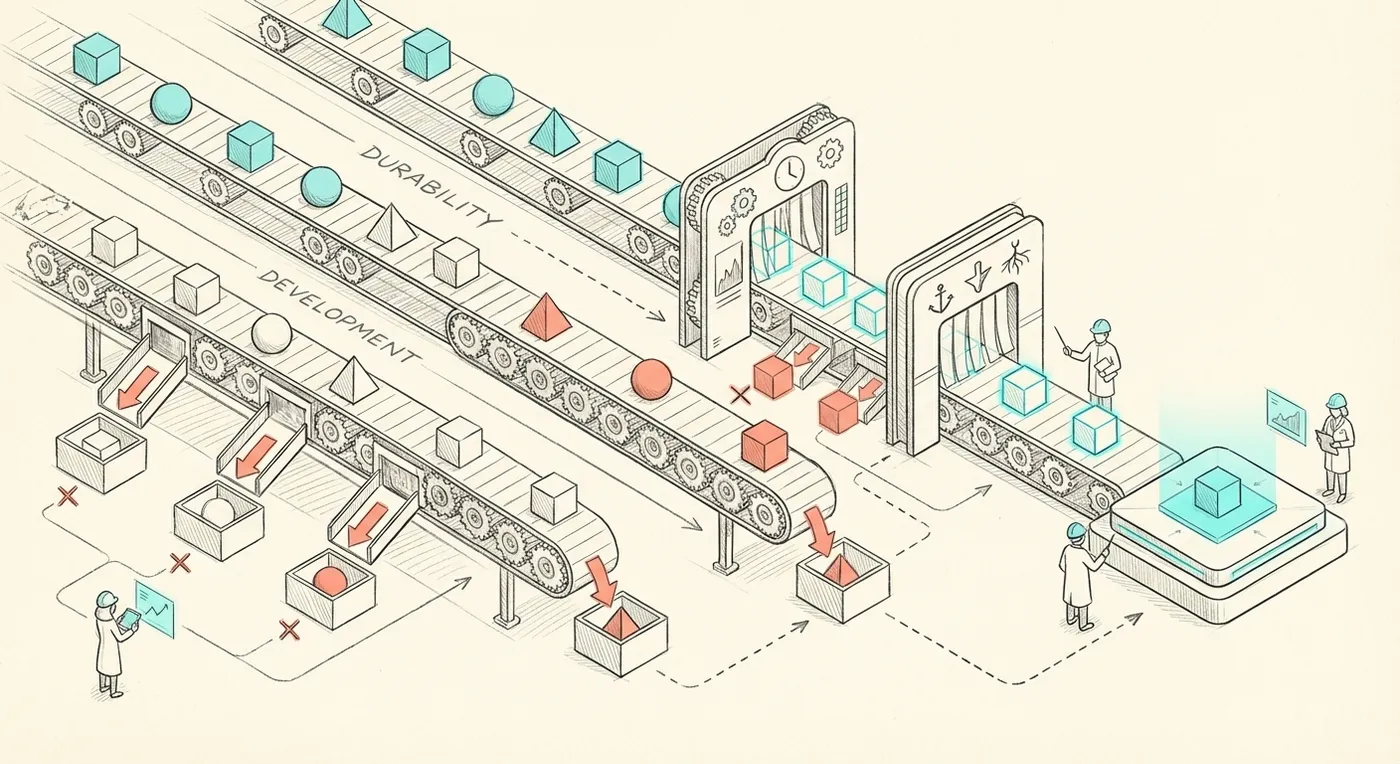
This is where our dual-filter approach comes in. We validate for two completely different things:
The Heat Filter
Does a tribe of real humans urgently want this problem solved?
We're looking for desperation, not politeness. Waitlists, community engagement, people actively seeking solutions.
The Durability Filter
Will this problem still matter (and generate revenue) 12-36 months from now?
Job frequency, economic buyer budget, potential for switching costs. We score ideas on future staying power.
The Heat Filter tells you what people want right now. The Durability Filter tells you what will still matter when the hype wears off.
Real talk: Most ideas that feel "hot" right now are actually just trend-riding. The dual filter helps us separate compounding niches from cash-flow micro-bets.
"The question he didn't ask: 'Will they still want this in 18 months?'"
2. AI Orchestration (More Than Better Prompting)
This is where things get interesting. Most people use AI like a smart intern, ask it a question, get an answer, move on. We tried that. It was chaos.
Individual AI tools are powerful, but they're like having a bunch of brilliant consultants who never talk to each other. The magic happens when you orchestrate them into a system.
Our product creation engine integrates multiple AI agents, each with specific roles:
- Insight & Narrative Strategist: Generates unfair insights and crafts compelling product narratives
- Market Scanner: Maps community heat and analyzes niche durability across datasets
- Test Engineer: Automatically generates unit, integration, and end-to-end tests
- Documentation Generator: Creates standardized briefs and decision records
The key insight? These agents feed into each other. The Market Scanner's output becomes input for the Insight Strategist. The Narrative Strategist's work informs the Test Engineer's scenarios.
We've cut our validation time from 6 weeks to 6 days, with better quality outputs than our manual process ever produced.
3. Portfolio Approach (Because All-In Bets Are for Casinos)
I learned this lesson the expensive way. Three months of nights and weekends building what I was certain would be my breakthrough SaaS. I had validation (sort of). I had a plan. I had conviction.
I also had exactly one idea in my pipeline.
When it became clear the market just wasn't there, I had to start over from zero. Brutal.
Now we maintain a portfolio of 8-12 ideas at various stages. That spread is how we make smarter decisions:
Portfolio Management in Action
Counterintuitively, having multiple options makes you less attached to any single idea. You can be honest about what's working and what isn't.
4. Documentation as a Feature (Not a Chore)
OK, hear me out on this one. I know "documentation" sounds about as exciting as watching paint dry, but this might be the most important piece of our entire system.
We document everything. And I mean everything:
- Unfair Insight Briefs for each round of market research
- Architecture Decision Records for every technical choice
- Validation scorecards with specific criteria and reasoning
- Post-mortem analyses on killed ideas (especially important)
Documentation is compound learning: every decision, insight, and failure becomes input for future decisions.
Six months ago, I was evaluating a new market niche. Instead of starting from scratch, I pulled up three similar analyses from our documentation system. Spotted patterns I would have missed. Avoided mistakes I'd made before. Saved probably 20 hours of research.
"Documentation is compound learning."
What Doesn't Work: Expensive Lessons
Now for the fun part, all the ways we screwed this up before getting it right. Consider this your shortcut to our hard-earned wisdom.
The Ad-Hoc AI Disaster
At 2 AM, I was firing random prompts at ChatGPT and calling it “market research.” “Analyze the productivity software market.” “What do small businesses need?” “Give me 10 SaaS ideas.”
The outputs were... confident nonsense, mostly. Without structured prompts, context, or quality controls, AI just hallucinates convincingly.
Lesson learned: AI without orchestration is like having a brilliant intern with ADHD and no supervision.
The Single-Idea Trap
I mentioned this earlier, but it deserves more attention because this mistake almost killed my motivation entirely.
When you have only one idea in your pipeline, you become emotionally invested in making it work. You ignore red flags. You rationalize weak validation signals. You build features nobody asked for because you can't bear to admit the core concept isn't viable.
Having multiple ideas doesn't make you uncommitted, it makes you honest.
The Build-First Temptation
Guilty as charged on this one. There's something intoxicating about building features. You can see progress. You can demo something. It feels productive.
But building before validating is like decorating a house before checking if the foundation is solid. I've wasted months building elegant solutions to problems nobody actually had.
The antidote? Force yourself to validate market fit before writing a single line of production code. Mock-ups and prototypes? Sure. Full features? Not until you've proven demand.
The Core Principles That Actually Matter
After a year of iterations, here are the principles that guide everything we do:
Validation is Continuous, Not Binary
Don't think "validated" vs "not validated." Think "current confidence level" and keep testing assumptions.
AI Needs Systems, Not More Prompts
Individual AI tools are powerful. Orchestrated AI systems change the work.
Portfolio Thinking Reduces Attachment
Multiple ideas in your pipeline make you ruthless about quality and honest about what's working.
Documentation Compounds Learning
Every decision becomes input for future decisions. Your past self becomes your best consultant.
What's Next: The Roadmap
We're nowhere near done. Here's what we're working on next:
Deeper AI integrations: Currently exploring how to connect our agents to real-time market data and community signals. Imagine validation that updates automatically as market conditions change.
Increased automation: The goal isn't to replace human judgment, it's to automate the tedious research so humans can focus on strategy and creativity.
Community-driven features: What if other product creators could contribute to and benefit from our validation system? Still early, but fascinating possibilities.
The Real Takeaway
Here's what I wish someone had told me a year ago: Build a learning system that gets smarter with each iteration. There is no perfect process waiting to be found.
The dual filters teach us what makes ideas durable. AI orchestration speeds up how fast we learn it. The portfolio approach keeps us honest about what's actually working. And the documentation means we never relearn the same lesson twice.
Most product failures aren't because people built the wrong thing badly. They're because people built the wrong thing too well.
"Most product failures aren't because people built the wrong thing badly. They're because people built the wrong thing too well."
The system we've built isn't perfect, but it's gotten us closer to building things people actually want and will pay for over time. And honestly? That's the only metric that matters.
What's your biggest challenge in validating product ideas? I'm genuinely curious what's working (or not working) for others in this space.
Want the Complete Framework?
The validation templates, AI orchestration playbooks, and portfolio tools from the product creation engine are available.
Open the complete systemWeekly
One email a week on product experience and AI-enabled delivery
What I'm working on, what broke, and what I'd do differently. Written for people running product organizations.