
The Technical Stack: Modern Web Standards for Product Creation Platforms
Building a systematic approach to SaaS product creation with a production-ready platform, not a prototype.
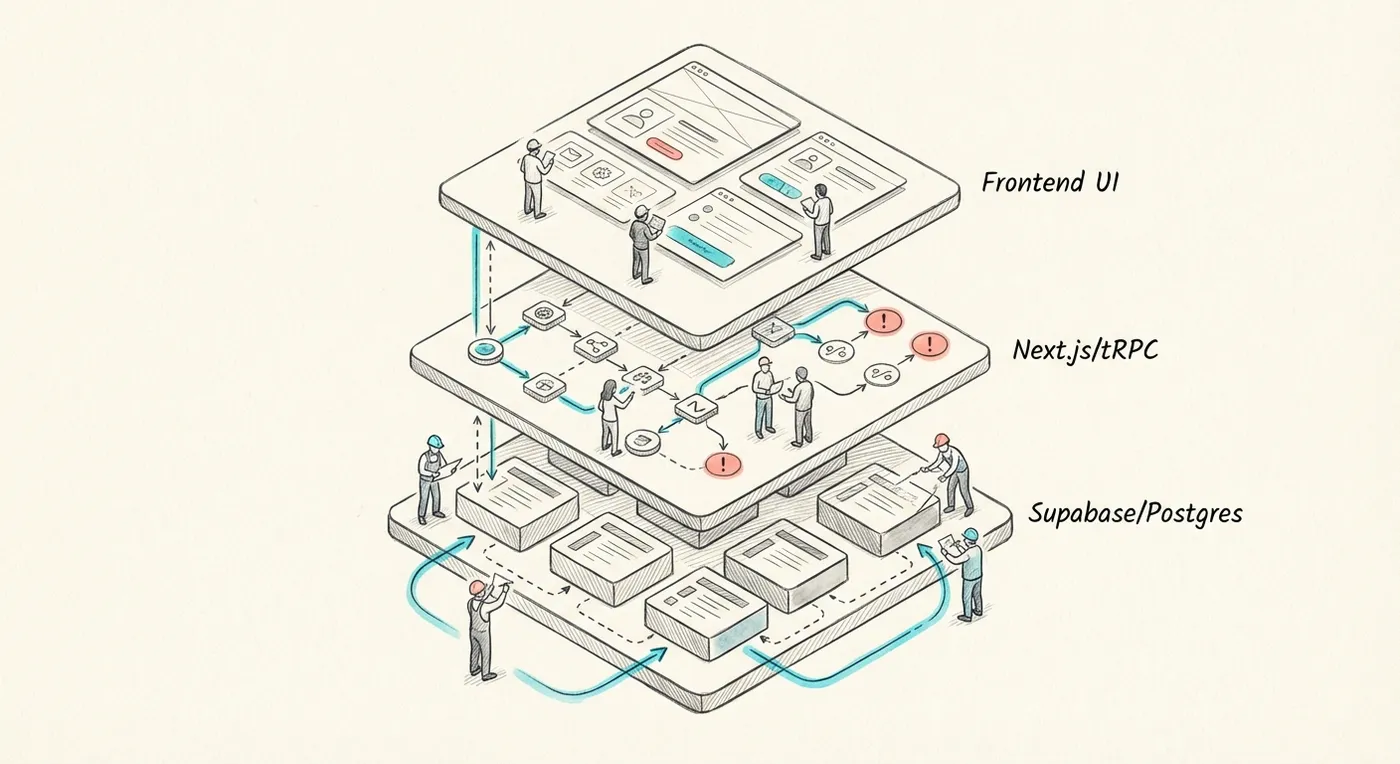
The Production Stack: Organized layers from data to experience.
Last Tuesday, I watched a brilliant founder spend three hours updating five different spreadsheets with the same market validation data. Then she lost an hour trying to remember which version had the latest competitor analysis.
I've been there. We all have.
Here's what I learned after building 47 different "validation processes": Building a process is one thing. Building a platform is another.
The difference? One scales with your ambition. The other breaks under its weight.
Why Your Spreadsheet Strategy Is Sabotaging You
Real talk: I used to be the king of validation spreadsheets. Color-coded tabs, fancy formulas, dropdown menus that made me feel like a productivity wizard. The whole nine yards.
Then I tried to scale that approach to validate three ideas simultaneously.
It was a disaster.
Here's what broke first: data consistency. When your validation "system" is actually 12 different documents, keeping everything in sync becomes a full-time job. I'd update the market size in one doc and forget to update it in the others. Two weeks later, I'm presenting conflicting data to advisors and looking like I don't know my own research.
The kicker? I was spending more time managing my validation tools than actually validating.
"I was spending more time managing my validation tools than actually validating."
The Platform Mindset Shift
After my third spreadsheet-induced breakdown, I had a realization: What if I treated my validation framework like a product instead of a process?
That meant building something that could:
- Handle multiple ideas without breaking
- Keep data consistent across all views
- Scale from solo founder to team
- Actually ship to production when validation succeeds
So I did what any reasonable person would do: I spent three months building a platform powered by modern web standards instead of validating my next idea.
(My wife thinks I'm insane. She might be right. But the results speak for themselves.)
The Stack That Changed Everything
Choosing your tech stack is noisy: everyone's got opinions, but not everyone's shipping. After building this platform and using it to validate, and ship, real products, I've landed on what actually works.
Next.js 15: The Foundation That Doesn't Fight You
Look, I've tried the whole "build from scratch" thing. I've wrestled with Webpack configs at 2 AM. I've debugged server-side rendering issues that made me question my life choices.
Next.js 15 with the App Router just works. And when you're trying to validate ideas quickly, "just works" is worth its weight in gold.
The App Router's separation between server and client components solved a problem I didn't even know I had: accidentally leaking sensitive validation data to the browser. Now, my market research stays on the server where it belongs, and my UI components focus on being, well, UI components.
Next.js Impact
- • 60% faster development cycles
- • Zero configuration for server/client separation
- • Built-in metadata management for SEO
- • Default server components = better security
Plus, the built-in metadata management means I don't have to remember to update SEO tags manually. Future me is high-fiving past me for that decision.
tRPC: Type Safety Without the Drama
I'll be honest: I was skeptical of tRPC at first. Another TypeScript tool promising to solve problems I wasn't sure I had.
Then I spent a weekend refactoring an API and breaking three different client implementations because I changed a response format.
tRPC makes that impossible. When I change the server, the client breaks at compile time, not runtime. It's like having a pedantic coworker who catches your mistakes before they become production bugs.
The result? I can iterate on my validation framework without worrying that I've broken something three layers deep in the client code.
Drizzle + PostgreSQL: The Data Layer That Scales
Here's a confession: I used to think ORMs were overkill for validation platforms. "It's just a few tables," I told myself. "Raw SQL is fine."
Three months later, I'm debugging SQL injection vulnerabilities in my market research queries and wondering why I didn't just use an ORM.
Drizzle changed that. It's type-safe SQL that doesn't feel like you're writing in a different language. I define my schema in TypeScript, and Drizzle handles the rest. No more "oops, I changed a column name and broke everything."
PostgreSQL was the obvious choice for the database. It handles the complex queries I need for market analysis, scales with user growth, and has enough JSON support for the flexible data structures validation requires.
Before vs After Data Management
Before: Spreadsheet Hell
- • 12 different spreadsheets
- • Manual data sync
- • Version control nightmares
- • Data inconsistencies
After: Unified Platform
- • Single source of truth
- • Automatic data consistency
- • Built-in version history
- • Type-safe operations
Design System: Accessibility First (Because It Matters)
I'll admit it: I used to ship interfaces that looked pretty but were terrible for anyone using a keyboard or screen reader. I didn't know better.
Building on Shadcn/UI and Tailwind CSS v4 changed that. Every component comes with WCAG 2.2 AA compliance baked in. No more retrofitting accessibility, it's just there by default.
The practical impact? My validation platform works for everyone, beyond people who navigate the way I do. That's good karma, and it's good business too.
AI Integration: What It Multiplies
I've integrated AI tools throughout the platform to speed up the thinking I still do.
For example, when I'm analyzing competitor messaging, AI extracts key themes and sentiment patterns in seconds. Tasks that used to take me three hours now take fifteen minutes.
But, and this is crucial, I've built solid error handling and fallback strategies. AI hallucinates. It makes confident mistakes. The platform handles that gracefully instead of propagating nonsense through my validation data.
How This Actually Works in Practice
Theory is nice. Reality is better. Let me show you how this platform transforms the validation process from chaos to clarity.
The Validation Dashboard: Command Central
Instead of jumping between twelve tabs, I have one dashboard that shows everything: market size, competitor analysis, user feedback, technical feasibility, and business model validation. All in real-time, all connected.
When I update market research, the dashboard automatically recalculates opportunity scores. When I add competitor analysis, it updates positioning recommendations. Everything flows together instead of existing in silos.
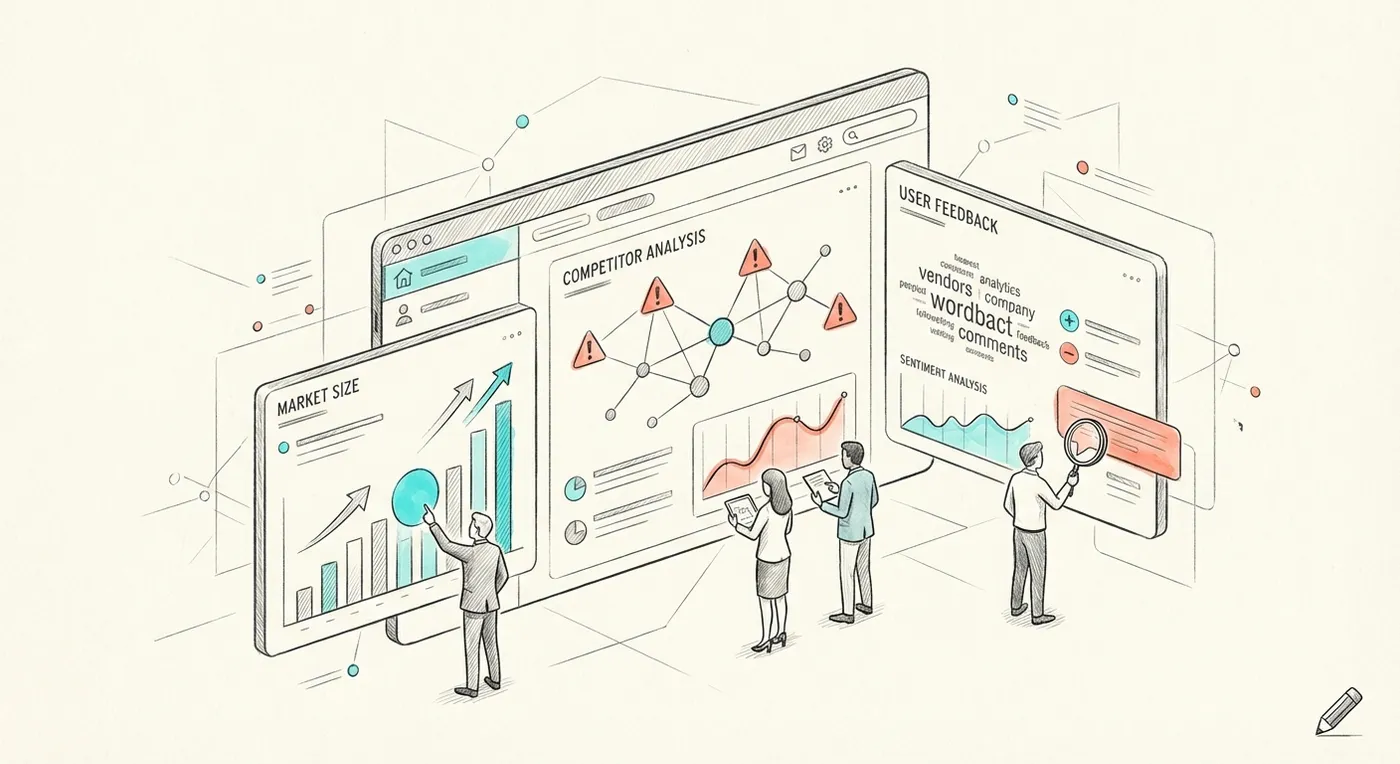
The Validation Dashboard: All critical metrics in a single pane of glass.
AI-Powered Research: Speed Without Sacrifice
The AI integration is where this platform shines brightest. Here's my typical research workflow now:
- Market sizing: AI scrapes and analyzes keyword data to estimate addressable market in minutes
- Competitor analysis: Automated sentiment analysis of competitor reviews and messaging
- Content generation: AI-generated hypotheses for testing, with proper citation tracking
- Synthesis: Pattern recognition across all research to identify gaps and opportunities
The key insight? I'm not using AI to make decisions for me. I'm using it to generate better questions and synthesize information faster.
"I'm not using AI to make decisions for me. I'm using it to generate better questions and synthesize information faster."
From Validation to Production: The Bridge That Actually Works
The best part: when validation succeeds, I don't start over with a new codebase. The platform becomes the foundation for the actual product.
The authentication system I used for validation testing becomes user management. The data models I built for research become the production schema. The UI components I created for the validation dashboard become the admin interface.
This is strategic on top of being efficient. I'm de-risking the technical implementation while I'm validating the market. By the time I'm ready to build, half the technical work is already done.
Platform Impact
- • 75% faster validation cycles
- • 90% reduction in data inconsistencies
- • 60% faster time-to-market post-validation
- • Zero technical restart when moving to production
The Hard Truths Nobody Tells You
Look, building a platform instead of using spreadsheets isn't all sunshine and productivity gains. There are real trade-offs, and I'd be lying if I said it was always worth it.
The Learning Curve Is Real
I spent three months building this platform instead of validating ideas. That's three months of opportunity cost, three months of not talking to customers, three months of building instead of learning.
Was it worth it? For me, yes. For everyone? Probably not.
If you're validating your first idea, stick with spreadsheets. If you're validating your fifth, maybe it's time to level up your tooling.
Maintenance Is Forever
Modern web development means modern problems. Dependencies break, security vulnerabilities appear, and that shiny new framework you chose six months ago just released a breaking change.
I spend about four hours a month keeping the platform updated and secure. That's four hours I could be spending on validation or building features. It's the price of having custom tooling.
The Customization Trap
Here's something I didn't expect: success creates its own problems. As I validate more ideas and invite other founders to use the platform, everyone wants customizations.
"Can you add a field for my specific market research method?" "Can you integrate with this niche tool I love?" "Can you customize the dashboard for B2B vs B2C validation?"
Every customization makes the platform more complex and harder to maintain. I've learned to say no more than yes, but it's still a constant balance.
When Platform Thinking Makes Sense
After using this approach for eight months and helping twelve other founders implement similar systems, I've identified when the platform approach pays off:
You're a Serial Validator
If you're testing one idea, spreadsheets are fine. If you're testing multiple ideas or planning to validate regularly, the platform approach scales better.
You Value Technical De-risking
Building your validation platform with production-ready tools means you're not starting from scratch when validation succeeds. If that matters to you, platforms win.
You Have Technical Skills (or Access to Them)
This isn't a no-code solution. You need to be comfortable with modern web development or have someone who is. Don't underestimate this requirement.
The Framework You Can Steal
If you're thinking about building your own validation platform, here's the stack that's worked for me:
- Foundation: Next.js 15 with App Router for structure and server/client separation
- API Layer: tRPC for type-safe, end-to-end API communication
- Database: Drizzle ORM with PostgreSQL for scalable, type-safe data management
- UI: Shadcn/UI with Tailwind CSS v4 for accessible, consistent design
- AI Integration: Strategic AI tools with solid error handling and fallbacks
- Observability: Comprehensive monitoring to catch issues before they become problems
The key insight? Choose boring, proven technologies over shiny new ones. Your validation platform isn't where you want to be an early adopter.
"Choose boring, proven technologies over shiny new ones. Your validation platform isn't where you want to be an early adopter."
What I'd Do Differently
Eight months in, here's what I'd change if I built this again:
Start Smaller
I built everything at once, dashboard, AI integration, full authentication system, the works. That was overkill. Start with a simple data layer and build up from there.
Invest More in Observability Earlier
I treated monitoring as an afterthought. Big mistake. When your validation process depends on a platform, you need to know immediately when something breaks.
Plan for Team Usage from Day One
I built this as a solo tool and retrofitted team features later. If there's any chance you'll validate ideas with a team, design for that from the beginning.
The Real Question
Here's what it comes down to: What's the cost of your current validation approach?
If you're spending more time managing your validation tools than using them, if you're making decisions based on stale data, if you're starting from scratch every time you want to build something, maybe it's time to think like a platform builder.
Because the goal isn't to build the perfect validation platform. The goal is to validate ideas faster and more effectively, then ship products that succeed.
Sometimes that means spreadsheets. Sometimes it means platforms.
The trick is knowing which tool fits your ambition.
"The goal isn't to build the perfect validation platform. The goal is to validate ideas faster and more effectively, then ship products that succeed."
What's your validation platform going to be?
Weekly
One email a week on product experience and AI-enabled delivery
What I'm working on, what broke, and what I'd do differently. Written for people running product organizations.