The Agent Layer Is Becoming the Business Layer
The agent layer is becoming the business layer: agent design is org design, and most companies still treat it like a model-selection problem.
Most of the AI work happening inside companies right now is feature work. A chat panel in the product. A model handed to employees. A handful of low-risk tasks automated, usage measured, adoption declared. Then a long quiet stretch where nobody can explain why the productivity story never showed up anywhere that matters.
The hard part is the level we're working at.
What's actually happening underneath the feature launches is that agents are starting to absorb work that used to live in job descriptions, team boundaries, and the undocumented connective tissue between them. Not as digital employees with vague mandates. As bounded systems that take a goal, pull the right context, run a workflow, check the result, and hand off what still requires judgment.
That's a different kind of change than adding AI to a product, and it's why so many pilots look sharp in a demo and thin in production. A model can generate an answer. It can't tell you which source of truth wins, which action it's permitted to take, what "good" looks like here, who owns the decision, or what to do when it isn't sure. Those are operating-design questions. We've been handing them to a model and hoping.
Bounded beats broad
The agents worth building don't look like assistants. They look like job descriptions with tighter edges: a specific trigger, a defined set of sources and tools, an expected output, a quality check that isn't just vibes, and an escalation path with a name attached to it.
The instinct to make them human-like works against all of that. A marketing agent told to grow the business is a demo. A marketing agent that takes a defined signal, retrieves approved positioning and proof points, drafts for a specific channel, validates claims against the system of record, routes for approval, publishes where it's authorized, and writes down what happened, that's an operating component. The second one is less fun to watch and far more useful to own.
Feature-level AI makes an individual faster. This changes what the organization can move through in a week.
What's actually being unbundled
For a long time the org chart was just the practical way to package work. You hired a marketing team because marketing meant a bundle of recurring tasks, specialized knowledge, systems access, judgment, and coordination. You hired operations people because someone had to keep things moving between functions.
Agents are pulling that bundle apart, and the first piece to move is the scaffolding around executive judgment and domain expertise: gathering inputs, applying known rules, preparing drafts, running standard checks, updating systems, chasing follow-ups, making sure the next handoff actually happens.
That's a large share of what we call operations. It's also a large share of what senior people quietly spend their week doing. The realistic outcome is a company where fewer people work as middleware between tools, documents, and queues.
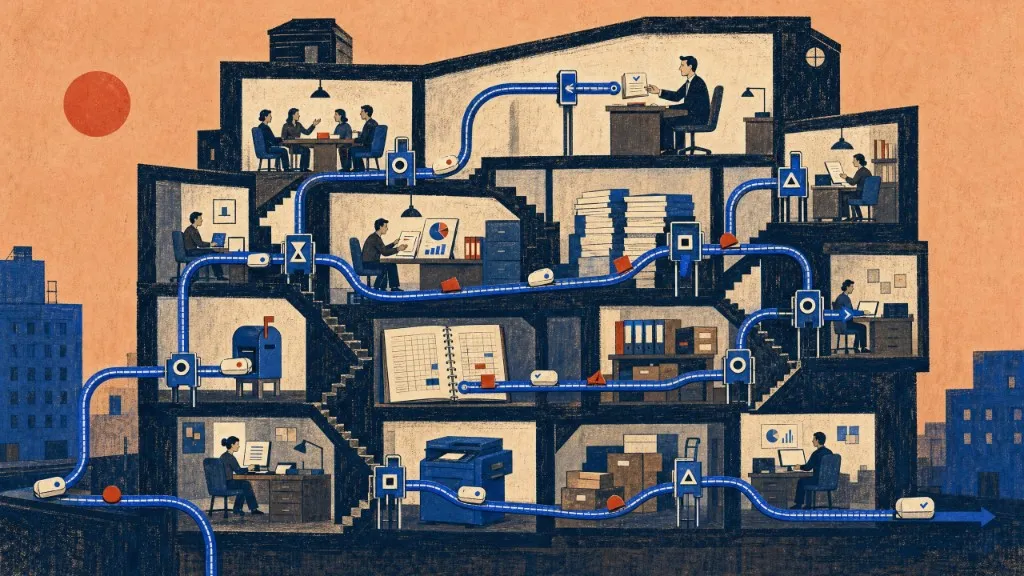
Which means the org chart stops being the only accurate picture of how work moves through the business. There's a second map now: which agents own which recurring workflows, what systems they can touch, what information they can see, where their authority stops, and who answers for the outcome. Almost nobody has drawn that map yet. In most companies, nobody has been asked to.
Context is the constraint, not capability
"Agents without durable context are fast interns with amnesia."
Every agent that does anything useful needs to know what the company knows: product decisions, customer commitments, policy, positioning, prior work, current priorities, the definitions that keep outputs consistent. When that lives in Slack threads, disconnected docs, private notebooks, and the heads of four senior operators, no amount of model quality rescues it.
This is the part that gets skipped because it isn't exciting. A usable company brain isn't a chatbot pointed at a document dump. It distinguishes a signed commitment from a brainstorm and a current decision from an abandoned one. It preserves the reasoning behind a decision, not just the decision, because the tradeoffs and the date and the owner are what make the next call better. It enforces permissions, because not every agent should see every document or take every action. And it improves from verified outcomes rather than from an agent claiming it learned something.
That documentation is the difference between a few isolated AI wins and something that compounds.
Where this goes wrong
The first failure is automating a broken workflow. If ownership is unclear, the rules contradict each other, the source data is weak, and there's no definition of done, an agent doesn't fix any of that. It runs the dysfunction faster and more consistently than the people who were quietly patching it by hand.
The second is designing for magic instead of reliability. Broad access, open-ended goals, and an impressive live demo, then unpredictable cost, inconsistent quality, and a security conversation nobody scheduled. Narrow scope, structured inputs, real tools, durable state, and observable output is a worse demo and a better system.
The third is the one I'd watch closest, because it hides inside good intentions. "A person will check it" is not a control system. It's an unpriced dependency, usually priced later by whoever is already overloaded. Review has to be aimed at the points where judgment, trust, risk, or irreversibility are actually concentrated. Everything else needs to validate itself against criteria someone wrote down in advance.
Three ways this goes wrong
Unclear ownership, contradictory rules, weak source data, no definition of done. An agent doesn't fix any of that. It runs the dysfunction faster and more consistently than the people who were quietly patching it by hand.
Broad access, open-ended goals, and an impressive live demo. Then unpredictable cost, inconsistent quality, and a security conversation nobody scheduled.
It's an unpriced dependency, usually priced later by whoever is already overloaded. Review has to go where judgment, trust, risk, or irreversibility are actually concentrated, not everywhere at once.
This gets non-negotiable in high-stakes domains. A decision-support agent should assemble evidence, surface alternatives, name the gaps, and preserve provenance, and it should not quietly make the call. A financial operations agent should monitor, reconcile, explain, and flag exceptions, and it should not present an unverified conclusion as advice.
The opportunity was never autonomy without limits. It's more work moving through the organization with less manual coordination, while accountability stays where someone can point at it.
The part we haven't decided
Start with one workflow that happens often, has definable inputs and outputs, and produces a result someone can measure. Map where context enters, where decisions get made, where systems get touched, where quality actually fails, and where a person has to keep authority. Then build the smallest loop that can do part of it safely, and get the evidence and observability working before chasing anything broader.
But the mechanics aren't the hard part, and I think we know that.
The hard part is that this is org design wearing a technical costume. Deciding what an agent is allowed to do, what it must prepare but never execute, what evidence it has to leave behind, and when a human takes the wheel, those are the same questions we've always asked about roles and accountability. They're just being asked faster now, with far less room to stay vague.
Someone has to own that work. Design, operations, and product have to sit in the same room and decide how the company actually runs. It does not belong only to whoever picked the vendor.
"I don't think most companies have figured out who that is. I'm less sure we've decided whether we want it to be us."
FAQ
What does it mean that the agent layer is becoming the business layer?
Agents are starting to absorb coordination work that used to live in job descriptions, handoffs, and undocumented process. Designing those agents means deciding authority, sources of truth, escalation, and accountability, the same questions as org design.
Why do agent pilots look good in demos and thin in production?
A model can generate an answer, but production work needs permission boundaries, quality checks, systems of record, and a named owner when judgment is required. Those operating-design decisions are usually missing from the pilot.
Who should own agent operating design?
Not the vendor picker alone. It belongs where design, operations, and product can decide how work actually runs: what an agent may execute, what it must only prepare, what evidence it leaves behind, and when a human takes the wheel.
Weekly
One email a week on product experience and AI-enabled delivery
What I'm working on, what broke, and what I'd do differently. Written for people running product organizations.